

You eat better than you ever have. You move when you can. And still, that stubborn layer around your midsection refuses to budge. After 50, your body shifts at the hormonal and cellular level.
Estrogen and testosterone decline, cortisol rises, and muscle tissue thins. Visceral fat, the deep abdominal fat wrapped around your organs, becomes a metabolic concern linked to insulin resistance, cardiovascular risk, and systemic inflammation.
Cutting calories and long cardio sessions address symptoms, not the real mechanism. In this article, you will get a science-backed 15-minute gentle resistance protocol built specifically for the post-50 body, starting today.
Burn Visceral Fat After 50: The 15-Min Gentle Fix

You eat better than you ever have. You move when you can. And still — that stubborn layer around your midsection refuses to budge.
Your body is working against you in ways nobody warned you about. After 50, your hormones shift. Your muscle quietly shrinks. And the fat around your belly stops behaving like the fat you dealt with in your 30s. It goes deeper. It wraps around your organs. And it laughs at long walks and salads.
But here's what nobody told you: the right kind of exercise — gentle, short, and smart — can reverse this. Not a little. A lot.
This article gives you a science-backed 15-minute resistance routine built for your body right now. You'll learn exactly why your belly fat changed, why this type of exercise beats cardio for fighting it, and how five simple kitchen swaps can multiply your results. There's a printable workout table at the end.
Why Your Belly Fat Changed After 50 — The Real Biological Reason

The Hormone Pivot Nobody Warns You About
For women, the drop in estrogen after menopause changes where fat gets stored. Research published in the journal Menopause found that women gain close to 1.7 pounds of visceral fat per year after menopause — without any change in their diet or activity level. That's not a lifestyle failure. That's biology.
For men, the picture is similar. Testosterone starts declining around 40, and by 55, muscle protein synthesis — your body's ability to build and hold on to muscle — can drop by 20 to 30 percent. Less muscle means a slower metabolism. A slower metabolism means more fat.
And here's the part that catches most people off guard: neither of these changes shows up on a regular scale. You can weigh the same as you did five years ago and still be carrying significantly more dangerous fat inside your belly.
Sarcopenia and Your Metabolic Engine
Sarcopenia sounds technical. The experience is simple: your muscles are getting smaller and weaker, even if you're active.
After 30, adults lose between 3 and 8 percent of their muscle mass per decade. After 60, the rate picks up. Each pound of muscle you lose reduces the number of calories your body burns at rest — by about 6 calories per day per pound.
That sounds small. Over 10 years, it adds up to a metabolic engine running hundreds of calories slower every single day. This is why the diet that worked at 40 stops working at 55. The body you're feeding has changed.
Why Visceral Fat Is Different From Regular Body Fat
There are two kinds of belly fat. One sits just under your skin — soft, pinchable, and cosmetically annoying. The other is visceral fat. It packs in around your organs: liver, intestines, and heart.
Visceral fat is not passive. It actively secretes inflammatory compounds called cytokines and dumps fatty acids directly into your bloodstream. This worsens insulin resistance, raises cardiovascular risk, and drives chronic low-level inflammation throughout your body.
Research in Physiological Reviews confirmed that visceral fat behaves more like an endocrine organ than stored energy — constantly disrupting your metabolism from the inside.
Add chronic stress to this picture — and adults over 50 often carry plenty of it — and the hormone cortisol makes things worse. Elevated cortisol specifically drives fat storage in the abdominal region. It's not random. It's targeted. And it responds to the right exercise like almost nothing else.
Why Gentle Resistance Training Beats Cardio for Visceral Fat After 50
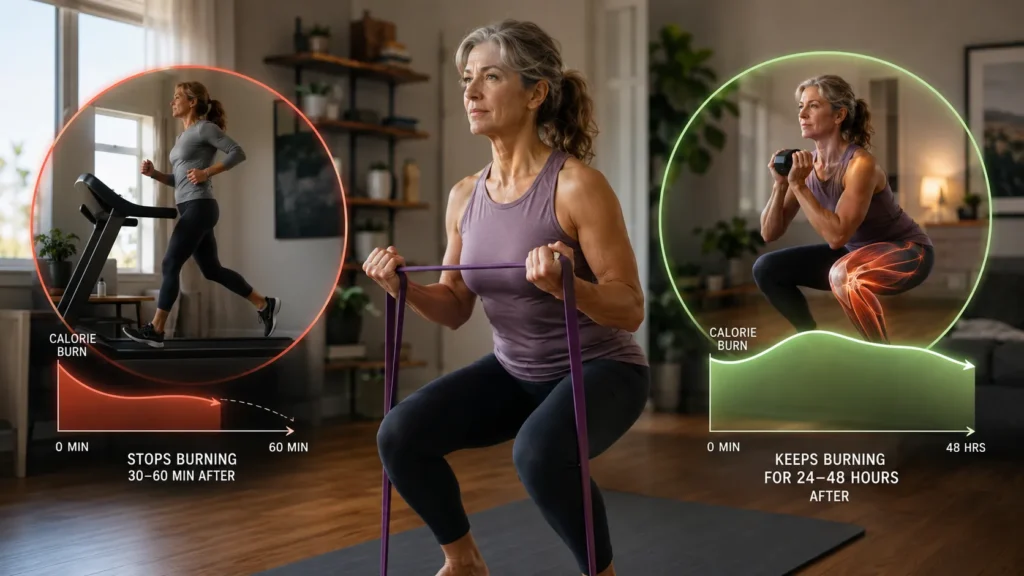
Most people over 50 reach for a treadmill or a bike when they want to lose belly fat. It's understandable. Cardio feels safe, familiar, and logical. But the science tells a different story.
The EPOC Effect, Explained Simply
When you do a cardio session — a brisk 45-minute walk, for example — your body burns calories during the activity. Then it stops. The metabolic effect ends about 30 to 60 minutes after you finish.
Resistance training works differently. It causes tiny tears in your muscle fibers. Your body then spends the next 24 to 48 hours repairing those fibers — burning extra calories the entire time.
This is called EPOC: excess post-exercise oxygen consumption. A 2011 study in Medicine and Science in Sports and Exercise confirmed that a single resistance training session can elevate your metabolism for up to 48 hours afterward.
Why Resistance Beats the Treadmill
Myth: Cardio is the best way to burn belly fat. Reality: Resistance training reduces visceral fat even without cutting calories.
A large review published in Obesity Reviews found that resistance training reduced visceral fat by an average of more than 6 square centimeters — without any dietary changes. Cardio reduced it too, but not by as much. And cardio doesn't build or preserve muscle, which is your long-term metabolic protection.
Myth: You have to work hard to get results. Reality: Low-load, slow-tempo resistance training produces equal muscle growth in older adults compared to heavy lifting — with far less injury risk.
Research published in the Journal of Applied Physiology confirmed this. You don't need heavy weights. You need the right stimulus.
Myth: Resistance training is hard on the joints. Reality: Low-load training places 40 to 60 percent less pressure on your knee joints compared to weighted squats.
For anyone living with stiff knees, achy hips, or a back that gives you trouble, this matters enormously.
Gentle = Effective. Here's the Science.
When you do resistance training, your muscles get better at pulling glucose out of the blood. This happens through special transporters called GLUT4. A 2004 study in Diabetes showed that resistance training increases GLUT4 activity for more than 24 hours after exercise.
That means your blood sugar stays lower, your insulin works better, and visceral fat has less of the hormonal environment it needs to accumulate. This is not a minor side effect. Insulin resistance is one of the core drivers of visceral fat storage after 50. Resistance training hits it directly.
Exercise Type Comparison: Impact on Visceral Fat and Metabolic Health After 50
| Exercise Type | Visceral Fat Reduction | EPOC Duration | Muscle Preservation | Joint Safety (50+) | Time Required |
|---|---|---|---|---|---|
| Gentle Resistance Training | ★★★★★ High | 24–48 hours | ★★★★★ Excellent | ★★★★★ Very Safe | 15–30 min |
| Steady-State Cardio (walking) | ★★★ Moderate | 30–60 min | ★★ Poor | ★★★★ Safe | 30–60 min |
| HIIT (High Intensity) | ★★★★ High | 12–24 hours | ★★★★ Good | ★★ Risky | 20–30 min |
| Yoga / Stretching | ★ Very Low | < 15 min | ★ Poor | ★★★★★ Very Safe | 30–60 min |
| Diet Alone (No Exercise) | ★★ Low | None | ★ Poor | N/A | N/A |
Based on findings from Ismail et al. (2012) Obes Rev; Knab et al. (2011) Med Sci Sports Exerc; Morton et al. (2016) J Appl Physiol. Ratings are comparative estimates, not clinical scores.
The 15-Minute Gentle Resistance Protocol — Your Exact Daily Plan
Here's the routine. It has three phases. You don't need a gym. You need a sturdy chair, a resistance band, and 15 minutes.
Three days a week — Monday, Wednesday, Friday works well. Take rest days in between. That's when your muscles rebuild and your metabolism runs hot.
Phase 1 — Activate (3 Minutes)
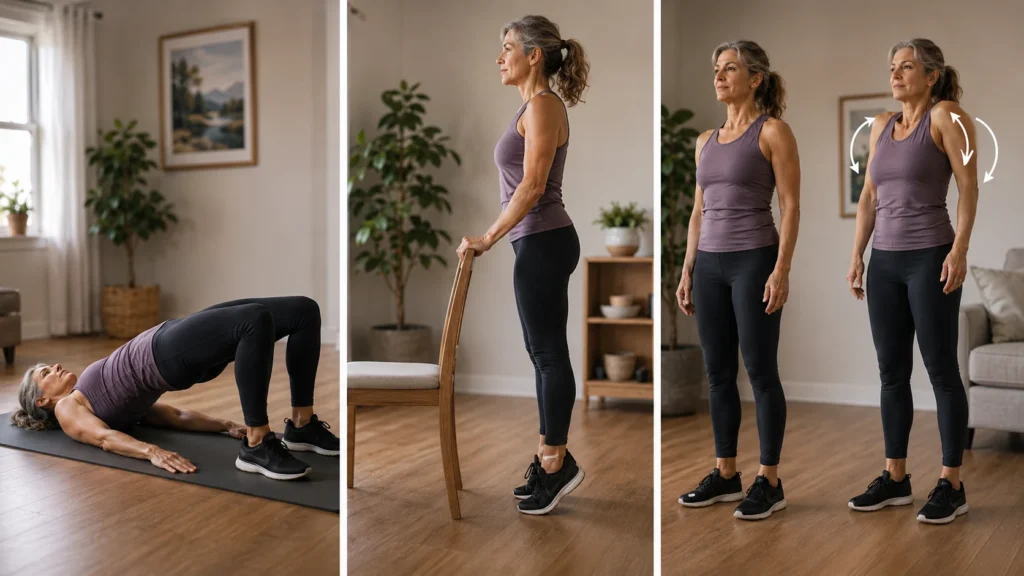
This phase wakes up your joints and gets blood moving before you ask your body to work. Warming up increases muscle temperature and improves force output by as much as 20 percent — meaning the resistance phase works better when you do this first.
Glute Bridges: Lie on your back, knees bent, feet flat on the floor. Push your hips up, squeeze your glutes, hold for 2 seconds. Lower slowly. 1 set × 10 reps. Rest 15 seconds.
Standing Calf Raises: Hold the back of a chair for balance. Rise up on your toes, hold for 1 second, lower slowly. 1 set × 12 reps. Rest 15 seconds.
Shoulder Rolls: Standing tall, roll both shoulders forward 5 times, then backward 5 times. Loosens the upper back and neck.
Phase 2 — Resist (10 Minutes)
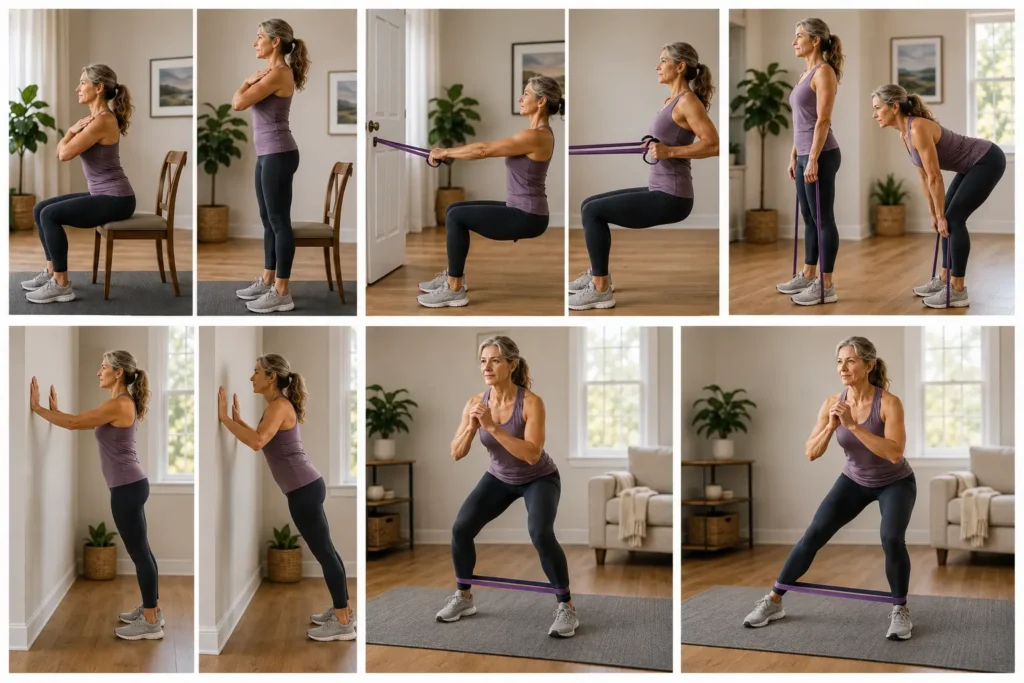
This is the engine of the protocol. Five compound exercises — meaning they use multiple muscle groups at once — to create maximum metabolic effect in minimum time.
Each exercise: 2 sets × 10–12 reps. Lower the weight (or your body) for 3 full seconds on every rep. Rest 30 seconds between sets. Take your time.
Sit-to-Stand Squat: Sit on the edge of a sturdy chair. Cross your arms over your chest. Stand up slowly, taking 1 second to rise. Sit back down, taking 3 seconds to lower. This targets quads, glutes, and core — the biggest muscle groups in your body.
Resistance Band Row: Anchor a band to a door handle or hold both ends in your hands. Stand or sit, back straight. Pull the band toward your waist for 1 second. Return slowly for 3 seconds. Works your upper back and biceps — muscles that help with posture and daily lifting.
Standing Hip Hinge: Stand with feet hip-width apart. Push your hips back slowly — 3 seconds — keeping your back flat, like you're closing a car door with your backside. Return to standing. Targets hamstrings and glutes — the muscles that protect your lower back and knees.
Wall Push-Up: Stand arm's length from a wall. Place palms flat on the wall at chest height. Lower your chest toward the wall for 3 seconds. Push back. Works chest, triceps, and shoulders without putting any pressure on your wrists or rotator cuffs.
Lateral Band Walk: Place a resistance band just above your ankles. Bend your knees slightly. Step 10 steps to the right, then 10 steps back. Slow and controlled. Targets hip abductors — the muscles on the outside of your hips — which stabilize your knees and support your lower back.
Phase 3 — Recover (2 Minutes)
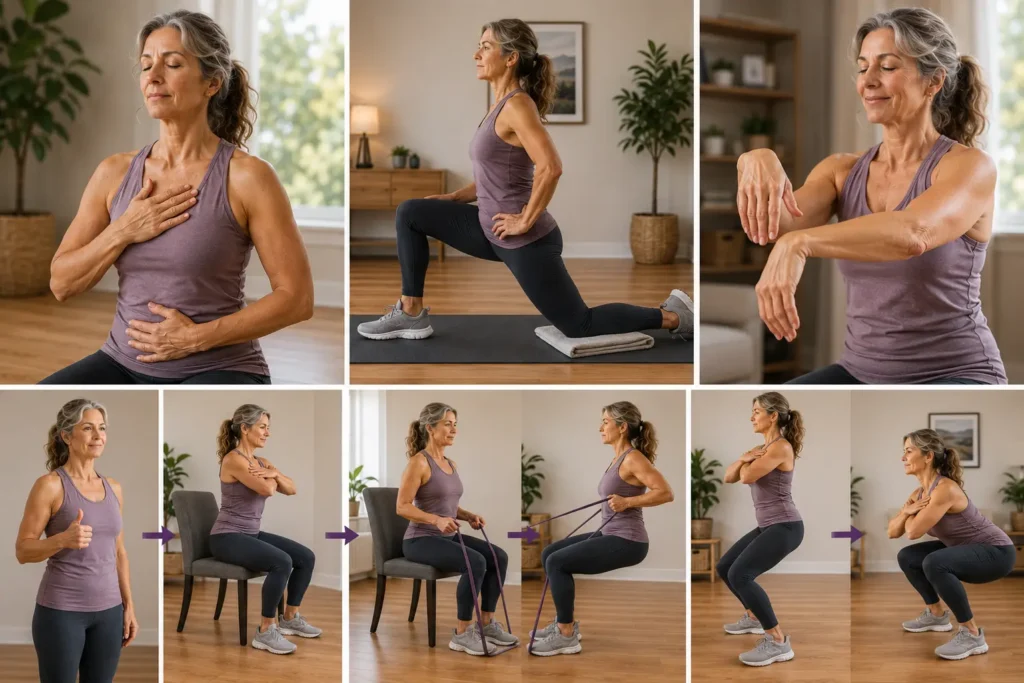
This phase matters more than most people realize. After exercise, your cortisol temporarily rises. A brief recovery routine activates your parasympathetic nervous system — the "rest and repair" mode — and brings cortisol back down faster.
Diaphragmatic Breathing: Sit or stand. Place one hand on your belly. Breathe in for 4 seconds, letting your belly rise. Breathe out for 6 seconds. Repeat 5 times.
Hip Flexor Stretch: Step one foot forward into a gentle lunge. Keep your back knee down (use a folded towel for comfort). Hold 20 seconds each side.
Wrist Circles: 5 slow circles in each direction. Releases tension held from typing, gripping, and everyday tasks.
How to Scale Up or Down
Starting out? Do 1 set of each exercise instead of 2. Use no band — just your body weight. You will still get results.
A few weeks in? Add the resistance band to sit-to-stand and rows in Week 3.
Ready for more? Add a third set, or extend the lowering tempo to 4 full seconds. You'll feel it.
Research confirms that even 3 months of this type of training, done three times a week, produces meaningful visceral fat reduction. Give it 12 weeks before you judge it.
The 15-Minute Gentle Resistance Protocol at a Glance
| Phase | Exercise | Sets × Reps | Tempo | Rest | Primary Muscles |
|---|---|---|---|---|---|
| ACTIVATE (3 min) | Glute Bridges | 1 × 10 reps | Normal | 15 sec | Glutes, Core |
| ACTIVATE (3 min) | Calf Raises | 1 × 12 reps | Normal | 15 sec | Calves, Balance |
| RESIST (10 min) | Sit-to-Stand Squat | 2 × 10 reps | 3-sec lower | 30 sec | Quads, Glutes, Core |
| RESIST (10 min) | Band Row | 2 × 10 reps | 3-sec pull | 30 sec | Upper Back, Biceps |
| RESIST (10 min) | Hip Hinge | 2 × 12 reps | 3-sec lower | 30 sec | Hamstrings, Glutes |
| RESIST (10 min) | Wall Push-Up | 2 × 10 reps | 3-sec lower | 30 sec | Chest, Triceps |
| RESIST (10 min) | Lateral Band Walk | 2 × 10 steps | Controlled | 30 sec | Hip Abductors, Glutes |
| RECOVER (2 min) | Diaphragmatic Breathing | 5 deep breaths | Slow | — | Nervous System Reset |
A light-to-medium resistance band (about 10–15 lbs of tension) is all the equipment you need beyond a sturdy chair. Bands cost $8–$12 at most pharmacies or online.
The Nutrition Bridge — Eating to Amplify the Protocol
Exercise is the spark. Food is the fuel. You can do this protocol perfectly three times a week and still slow your results if your nutrition is fighting against you.
You don't need a complicated plan. You need a few targeted shifts.
Protein First — Why Your Muscles Are Hungry

After 50, your body becomes less efficient at using protein to build muscle. This is called anabolic resistance. To overcome it, researchers recommend adults over 50 eat 1.2 to 1.6 grams of protein per kilogram of body weight each day — significantly more than the standard dietary guidelines suggest.
For a 150-pound person, that's roughly 80 to 110 grams of protein per day. Most adults over 50 eat far less than that.
And the timing matters too. Consuming 20 to 40 grams of high-quality protein within two hours of your resistance workout maximizes muscle repair and synthesis in older adults, according to research published in the Journal of Gerontology. A hard-boiled egg and Greek yogurt after your session isn't just a snack. It's recovery medicine.
5 Kitchen Swaps That Support Visceral Fat Loss
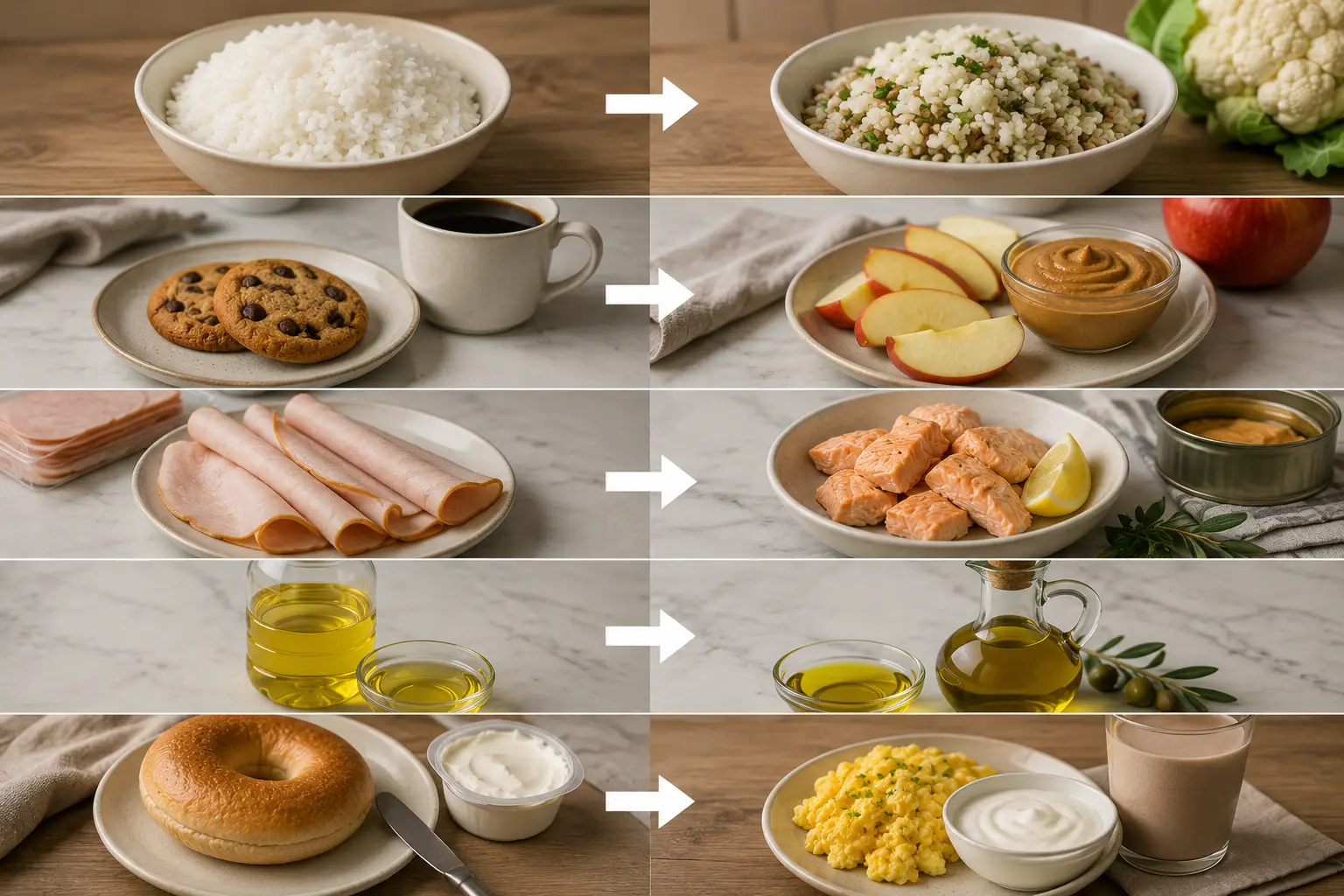
These are simple. You don't need to change everything at once. Start with one this week.
White rice → Cauliflower rice mixed 50/50 with brown rice. You lower the glycemic load of your meal — meaning less blood sugar spike, less insulin surge, less visceral fat signal.
Afternoon cookie → 2 tablespoons almond butter on apple slices. You get protein, healthy fat, and polyphenols instead of refined sugar hitting your bloodstream at your most sedentary time of day.
Processed deli meat → Canned wild salmon. One swap, three wins: omega-3 fatty acids, anti-inflammatory compounds, and lean protein that supports muscle.
Vegetable oil → Extra-virgin olive oil. Olive oil contains oleocanthal, a natural compound that reduces inflammation in a way that researchers have compared to low-dose ibuprofen — without the side effects.
Skipping breakfast → A 30-gram protein breakfast. Eggs, Greek yogurt, a protein shake with milk, smoked salmon on whole grain — pick one. A protein-rich breakfast activates the muscle-building pathway (mTOR) early in the day and reduces hunger and cravings by mid-afternoon.
The Post-Workout Window
Your muscles are most receptive to protein in the two hours after your resistance session. A Mediterranean-style eating pattern — built around olive oil, fatty fish, colorful vegetables, and legumes — has been shown in research published in the Journal of the American College of Cardiology to reduce visceral fat and inflammatory markers in adults over 50. You don't need a diet overhaul. You need a direction.
Building the Daily Habit — A Quick Checklist for Week 1
The protocol only works if you do it. And doing it consistently is where most people struggle. Not because they're lazy — but because they have no system.
Here's a simple one.
Morning Activation
Drink 16 oz of water as soon as you wake up. Rehydration after sleep supports healthy cortisol regulation from the start of your day.
Eat 25 to 30 grams of protein within 60 minutes of waking. This counters the natural cortisol spike in the morning and activates your muscle-building system early.
On workout days (Mon / Wed / Fri), complete your 15-minute protocol before life gets busy. On off-days, a gentle 20-minute walk is all you need.
Midday Nutrition Anchor
Include a protein source at lunch — 4 ounces of chicken, fish, a cup of legumes, or Greek yogurt.
If you sit at a desk, take a 5-minute standing break every 90 minutes. Even brief standing reduces the metabolic slowdown caused by prolonged sitting.
Drink water until your urine is pale yellow. Dehydration impairs muscle protein synthesis by up to 12 percent — most people don't realize their muscles need water to rebuild.
Evening Recovery
Aim to finish eating 2 to 3 hours before sleep. Research shows this improves overnight fat oxidation — your body burns more fat while you sleep when it isn't busy digesting a late meal.
Spend 5 minutes doing deep breathing or light stretching before bed. This activates your parasympathetic nervous system, lowers cortisol, and improves sleep quality.
Before you put your phone down, write one positive movement win in your notes app. "Did the workout." "Took the stairs." Anything counts. Studies show that behavioral self-monitoring like this doubles exercise adherence over a 12-week period. That's not a motivational tip. That's data.
Your Biggest Questions, Answered Honestly
Is 15 minutes really enough to lose visceral fat?
Yes — when the structure is right. A study in the Journal of Sports Science and Medicine found that 12 weeks of resistance training, done three times per week in sessions of 20 to 30 minutes, significantly reduced visceral fat in adults over 50 without any dietary changes.
The key is consistency and using compound movements that recruit large muscle groups. Longer sessions are not necessarily better sessions.
What if I have bad knees or a bad back?
This protocol was specifically built with joint safety in mind. All five resistance exercises can be done seated or modified for limited mobility. Wall push-ups take pressure off the shoulders.
The hip hinge uses no external weight. If you have a diagnosed condition, check with your doctor before starting — but the low-load, slow-tempo format used here is often the exact approach physical therapists recommend for joint rehabilitation. You don't have to push through pain to get results.
How long until I see results?
Expect to feel results before you see them. More energy, better sleep, reduced bloating, and a clearer mind typically show up within the first 2 to 4 weeks. Measurable visceral fat reduction — confirmed by multiple clinical studies — tends to appear between 8 and 12 weeks of consistent effort. Stay patient. The biology is working even when the mirror isn't showing it yet.
Do I need equipment?
No. The bodyweight-only version of this protocol produces real results. A resistance band — which costs under $15 at most pharmacies — adds progressive overload that speeds things up, especially for rows and lateral walks. A sturdy chair is your only essential. No gym membership required.
Can I do this every day?
Not this specific protocol. Three days per week with rest days in between is the optimal frequency. Muscle repair happens during rest — not during exercise.
Doing this every day would actually slow your results by preventing that repair cycle from completing. On off-days, a 20 to 30 minute walk at a pace where you can comfortably hold a conversation is ideal. It improves your mitochondria — the energy factories inside your cells — without interfering with recovery.
Start Here. Right Now.
The metabolic changes you're dealing with are real. They're well-studied. And they affect nearly every adult over 50 who hasn't taken specific action to counter them.
But here's what the research also shows: the body responds. At 55, 62, 68 — it responds. Muscle grows. Visceral fat shrinks. Blood sugar improves. Energy comes back. This is not wishful thinking. It is documented biology.
The three things to hold onto from this article: gentle resistance training is the most powerful tool you have for visceral fat after 50; 15 minutes done three times per week is clinically enough to trigger the metabolic response you need; and adding protein-forward, anti-inflammatory foods multiplies every hour of effort you put in.
Print this protocol. Screenshot the workout table. Set three calendar reminders for this week.
Your metabolism is not broken. It just needs the right signal. Start today — and let your body remind you what it's still capable of.
Your Take-Home Reference Card
| Core Concept | The Science | Your Action Step | Expected Benefit by Week 12 |
|---|---|---|---|
| Hormonal Metabolic Shift After 50 | Estrogen/testosterone decline drives visceral fat accumulation and muscle loss | Stop blaming willpower — start a muscle-building protocol this week | Improved self-efficacy; realistic expectations replace frustration |
| Gentle Resistance Training | Reduces visceral fat by 6+ cm² without dieting; EPOC lasts 24–48 hours | Do the 15-min protocol 3x/week on non-consecutive days | Measurable visceral fat reduction; improved insulin sensitivity |
| EPOC Metabolic Afterburn | Resistance training keeps metabolism elevated for up to 48 hours post-session | Track workout days on your calendar to build a visible streak | Higher resting calorie burn; lower fasting blood glucose |
| Protein-First Nutrition | 1.2–1.6g/kg/day prevents sarcopenia and supports muscle repair | Add 20–30g protein to breakfast today (eggs, Greek yogurt, salmon) | Better muscle retention; reduced hunger and cravings |
| Anti-Inflammatory Kitchen Swaps | Mediterranean-style eating reduces visceral fat and inflammatory markers | Make one kitchen swap per week — start with olive oil and fatty fish | Reduced bloating; improved triglycerides and HDL cholesterol |
| Daily Habit Stacking | Self-monitoring doubles exercise adherence over 12 weeks | Screenshot the morning checklist and put it on your bathroom mirror | Consistent routine; compounding metabolic benefits over time |
| Post-Workout Recovery Window | 20–40g protein within 2 hours of exercise maximizes muscle synthesis | Prepare a protein-rich snack before each workout session | Faster recovery; reduced next-day soreness; better adherence |
| Joint-Safe Exercise Design | Low-load training produces equal muscle growth with 40–60% less joint compression | Start with all bodyweight modifications; add band resistance in Week 3 | No injury setbacks; a sustainable long-term exercise habit |
