

Walking is one of the simplest ways to stay active as you age, but small changes in your stride and posture may affect how comfortably your body handles each step.
Research shows that regular walking can support healthy aging and may reduce the risk of chronic low back pain. Good technique can also make walking feel smoother, especially if years of sitting have encouraged slouching or poor movement habits.
The goal is not to force a perfect stride or push through pain. Instead, a few practical adjustments can help you walk naturally, support your back, and build a movement habit.
Walk Smarter.
Protect Your Back.
Four small walking adjustments that can make everyday movement more comfortable.
4 Simple Walking Fixes
Shorten Your Stride
Take smaller, quicker steps instead of reaching too far forward.
Stack Your Spine
Keep your head level, shoulders relaxed, and hips aligned as you walk.
Engage Your Core Gently
Lightly activate your abdominal muscles without tensing hard or holding your breath.
Swing Your Arms Naturally
Let opposite arms and legs move together to maintain a comfortable walking rhythm.
Why Walking Is Both the Problem and the Answer

Here is the strange truth about back pain. The activity your doctor tells you to do more of is also the activity most people do completely wrong.
Walking seems too simple to get wrong. You have been doing it since you were a toddler. But the way most adults walk after decades of sitting at desks, staring at phones, and shuffling through airports is not the walk your spine needs. It is the walk that slowly breaks it down.
Back pain is not a rare problem. It is the leading cause of disability on the planet. In 2020, around 619 million people were living with lower back pain. By 2050, that number is expected to top 843 million, according to The Lancet Rheumatology. That is more than the entire current population of Europe.
The heaviest burden falls on people aged 50 to 55. That is also the age when movement habits feel most locked in.
But here is the hopeful part. A major study from Macquarie University, published in The Lancet in 2024, followed 701 adults and put this to the test. People who followed a structured walking program had 28% fewer back pain recurrences.
They also had 43% fewer episodes where they had to seek medical care. The group that walked correctly went a median of 208 days before their pain came back. The group that did not? Just 112 days.
Professor Mark Hancock, who led the research, put it plainly. “The loading that’s associated with walking is really good for the health of many of the structures in the spine. Many tissues, like bone, respond well to loading. If we don’t load them, they become weak.”
Walking loads the spine in a gentle, rhythmic way. It keeps the discs fed. It keeps the bones strong. It keeps the muscles tuned.
But here is the catch. That benefit only shows up when the walk is mechanically sound. So what does walking incorrectly actually look like?
The Five Walking Mistakes That Age Your Spine Fastest
Picture a typical morning walk. Someone steps outside into the fresh air, head tilted down toward the footpath, shoulders rolled forward, lower back arching out behind them, taking big sweeping strides that reach far ahead of their body.
From the outside, it looks like exercise. From the inside, five separate mechanical errors are loading the lumbar spine with every single step.
And these mistakes are layered. One leads to the next. By the time you add them all up, the spine is absorbing stress it was never designed to handle repeatedly.
Mistake 1: Overstriding
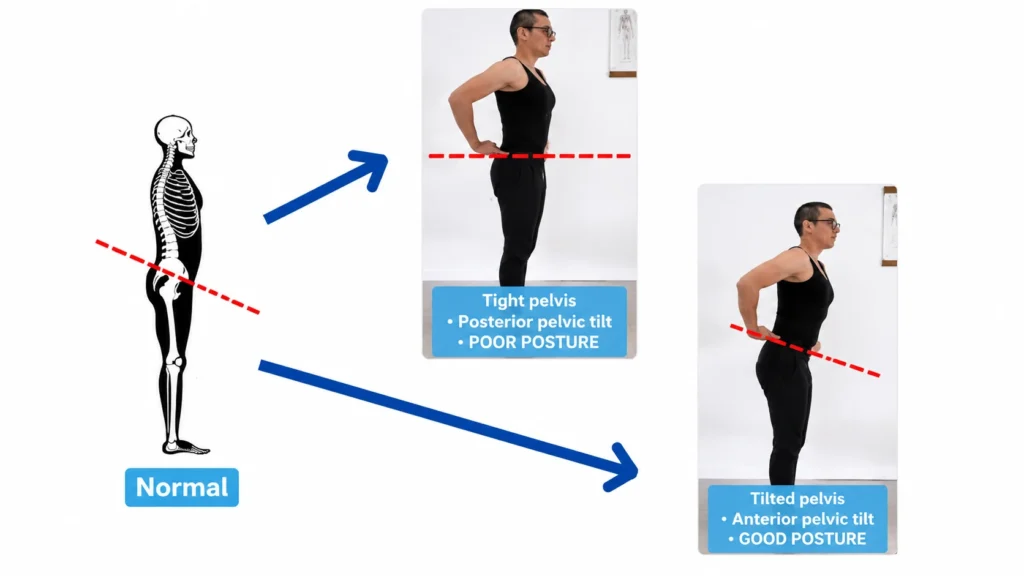
When you take steps that are too long, your foot lands well ahead of your body. That forces your leg to act like a brake with every step. Your body then has to push through that resistance to keep moving forward.
Physical therapists consistently flag overstriding as one of the first things they correct. When your stride reaches too far out in front, it creates tension in the hip flexors and pulls the pelvis into a forward tilt. That tilt goes straight to the lower back. Shortening stride length is often the first adjustment a physio will recommend.
Mistake 2: Anterior Pelvic Tilt (the duck walk)
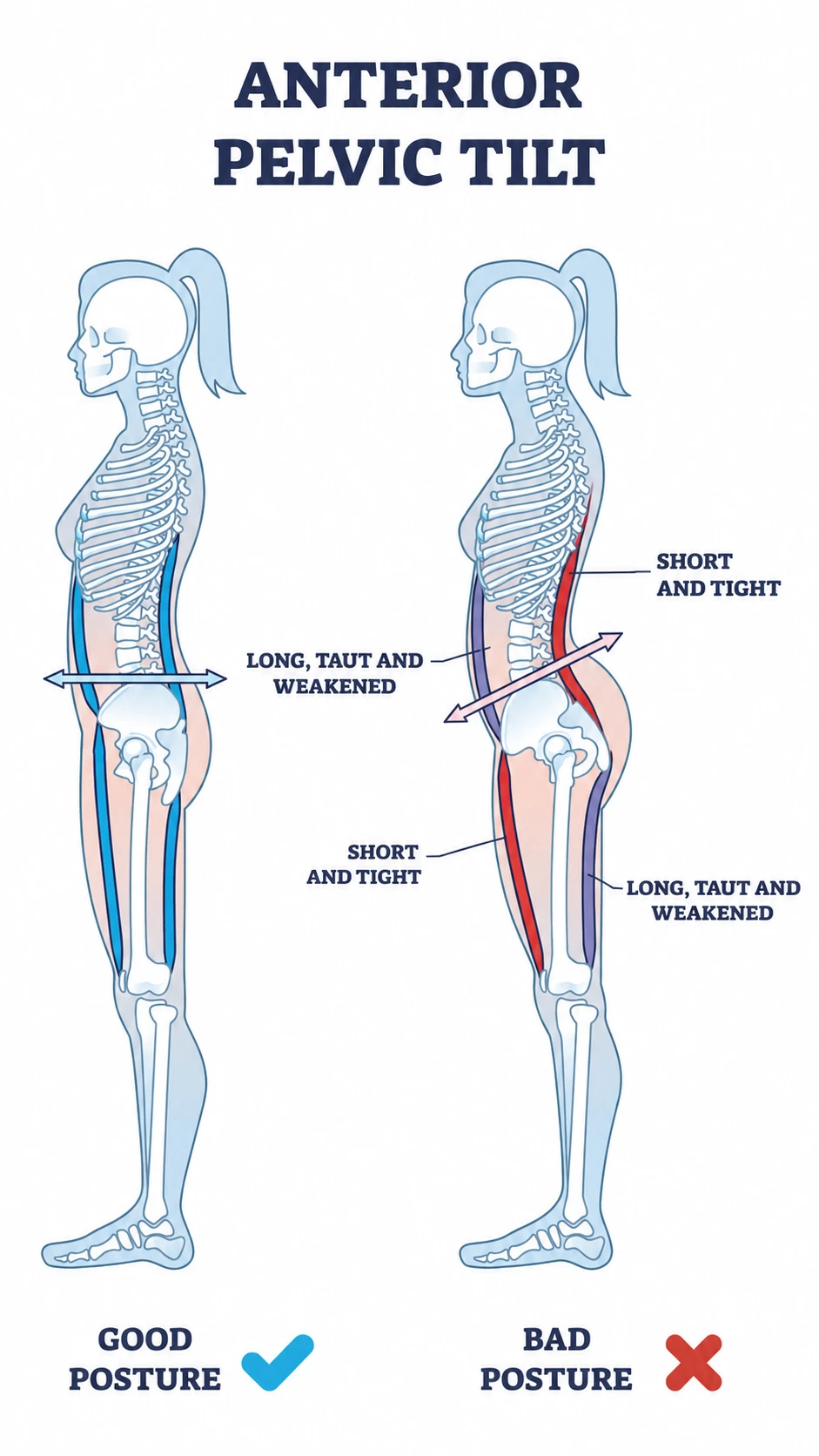
This is when the pelvis tips forward and the lower back arches inward more than it should. It comes from too much sitting and not enough movement. Over time, the hip flexors tighten, the glutes stop firing properly, and the pelvis tilts forward as the new default.
When you carry this into your walk, the arch deepens with every step. The lumbar vertebrae compress. The discs take more load than they can handle long-term.
Mistake 3: A Disengaged Core
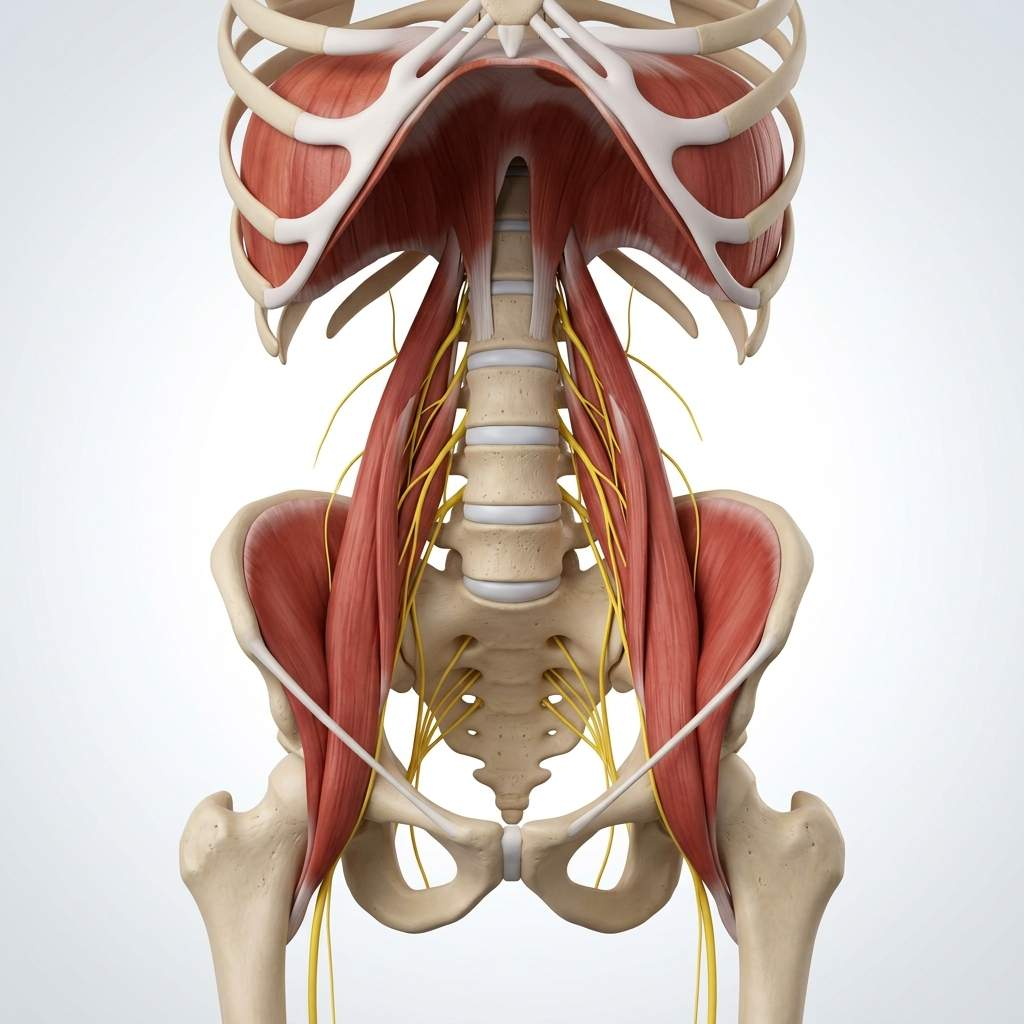
Most people think the core is just the stomach muscles. It is not. The core includes deep abdominals, obliques, back extensors, hip stabilizers, and the pelvic floor. All of these work together to keep the spine stable while the legs and arms move.
When the core is switched off during walking, something else has to pick up the slack. That something is almost always the lower back. Over time, the lower back muscles work overtime, get overloaded, and start to inflame.
Mistake 4: Forward Head Posture and Hunched Shoulders
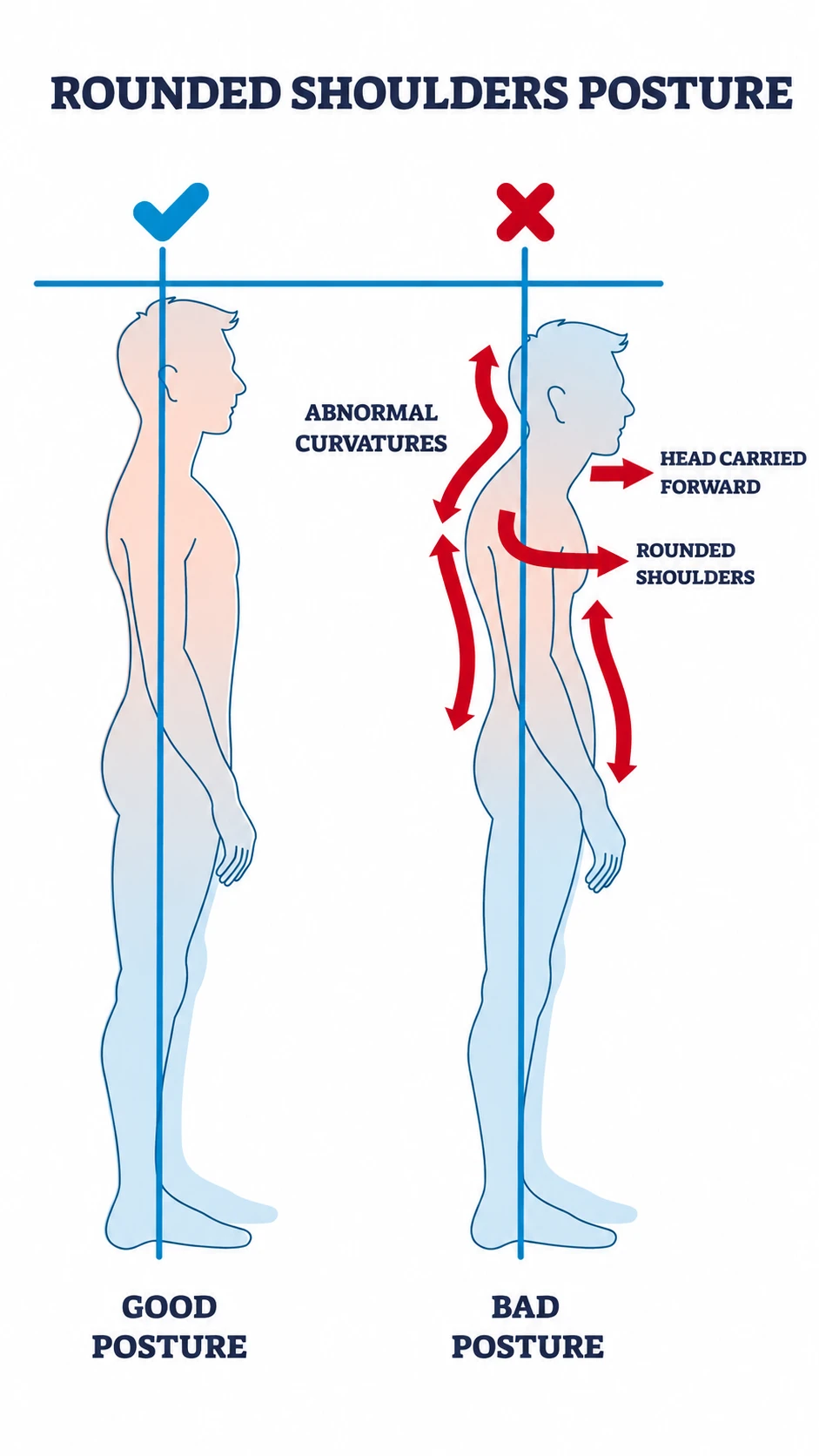
Every centimeter your head drifts forward adds roughly ten pounds of load to the neck and upper back. When the head pulls forward, the shoulders follow. The upper back rounds. And because the spine works as one connected system, that rounding at the top translates directly into extra strain at the bottom.
It also changes how efficiently you walk. A head-forward posture shortens your stride, reduces trunk rotation, and makes every step slightly harder than it needs to be.
Mistake 5: Locked or Absent Arm Swing
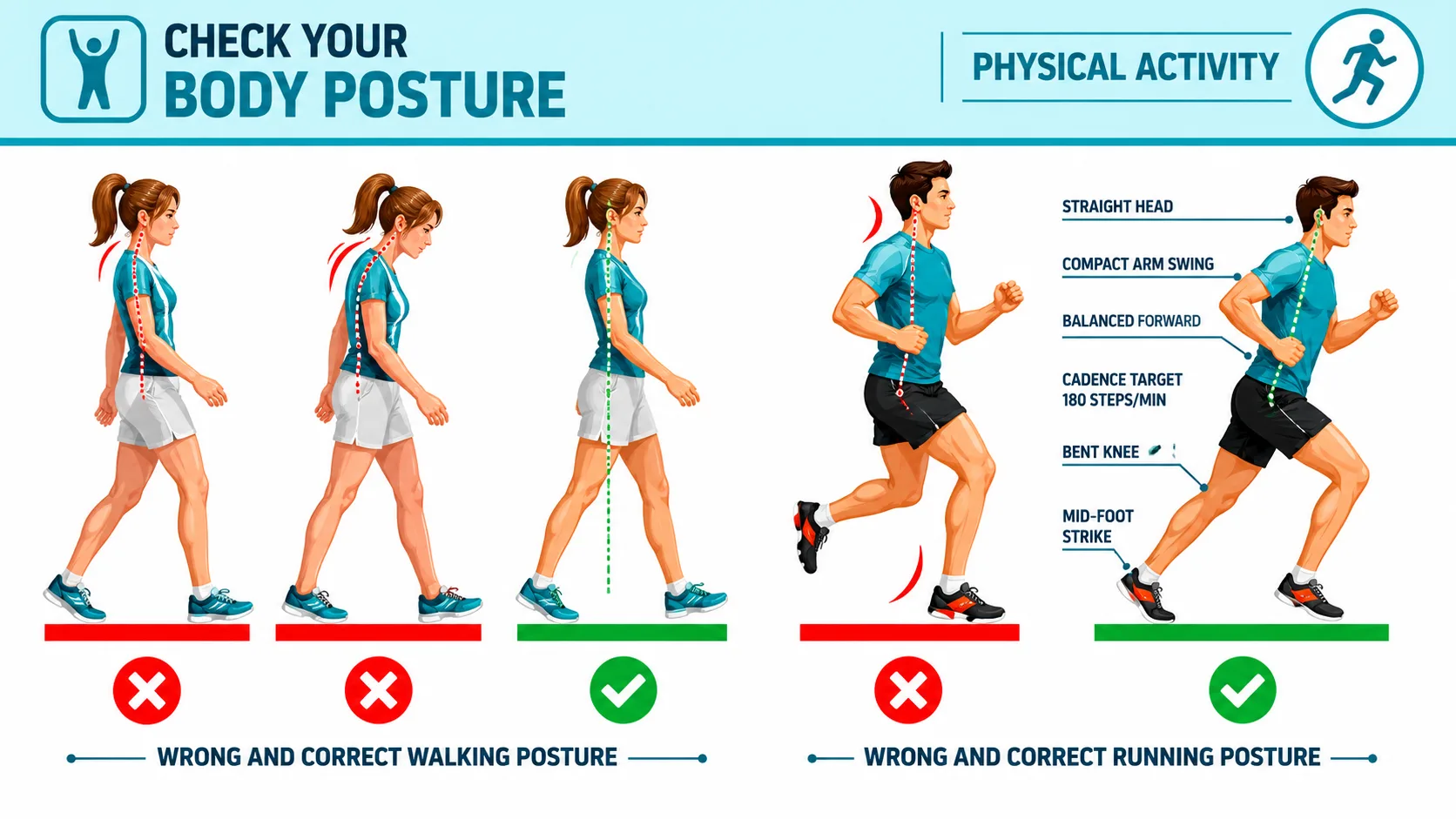
Arms swinging freely while you walk are not just cosmetic. They counterbalance the rotation of your pelvis and legs. Without that counterbalance, the trunk gets stiff, the lower back absorbs torsional stress it shouldn’t, and your balance quietly worsens over time.
Phone in one hand, other hand in a pocket? Your arm swing is already compromised. Your trunk is already not rotating the way it should. And your lower back is already compensating.
These five mistakes compound each other. Overstriding leads to anterior pelvic tilt. Anterior pelvic tilt weakens the core’s ability to stabilize. A weak, disengaged core stiffens the arms. Stiff arms amplify forward head posture. And the whole cycle repeats, thousands of times per walk.
The good news is that none of this requires years of physical therapy to fix. The adjustments are simple. Most take about ten seconds to learn and a few weeks to make automatic.
The Six Adjustments That Turn Your Walk Into a Back-Protecting Habit
If a physical therapist watched you walk down the street, these are the six things they would assess. You do not need to change all six at once. Start with one. Add another next week. Within a month, your walk will feel completely different.
Adjustment 1: Shorten Your Stride and Quicken Your Steps
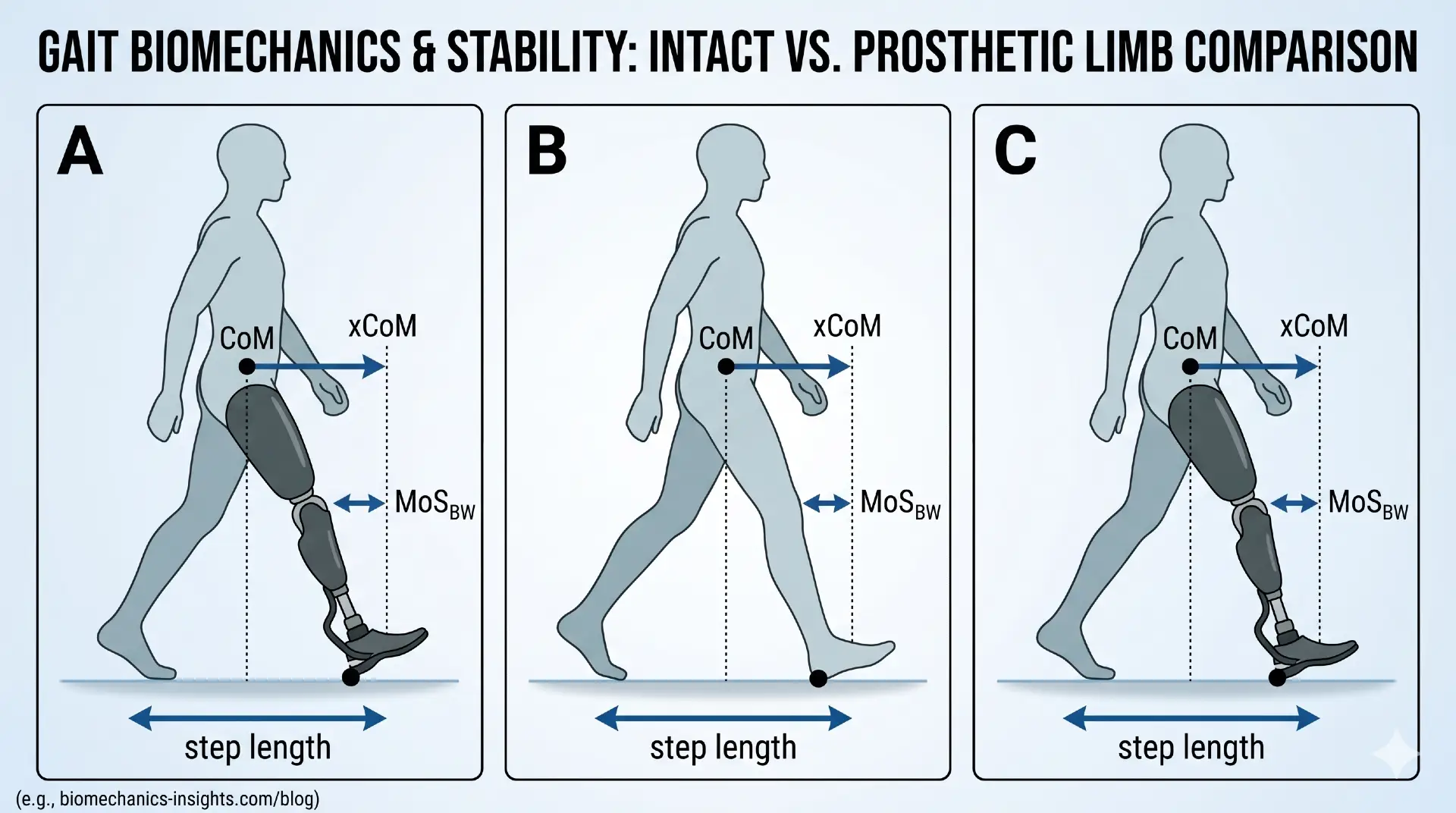
More steps per minute, not longer steps. That is the goal. It seems counterintuitive. But a shorter, quicker stride reduces the braking force on the lower back and takes pressure off the hips and knees at the same time.
Your leg should feel like it is stepping forward from above the hip, not reaching out from the foot. A practical way to start: count your steps for one minute and try to add five to ten more steps in the same time without walking any faster. Just smaller, snappier steps.
Adjustment 2: Stack Your Body from the Ground Up
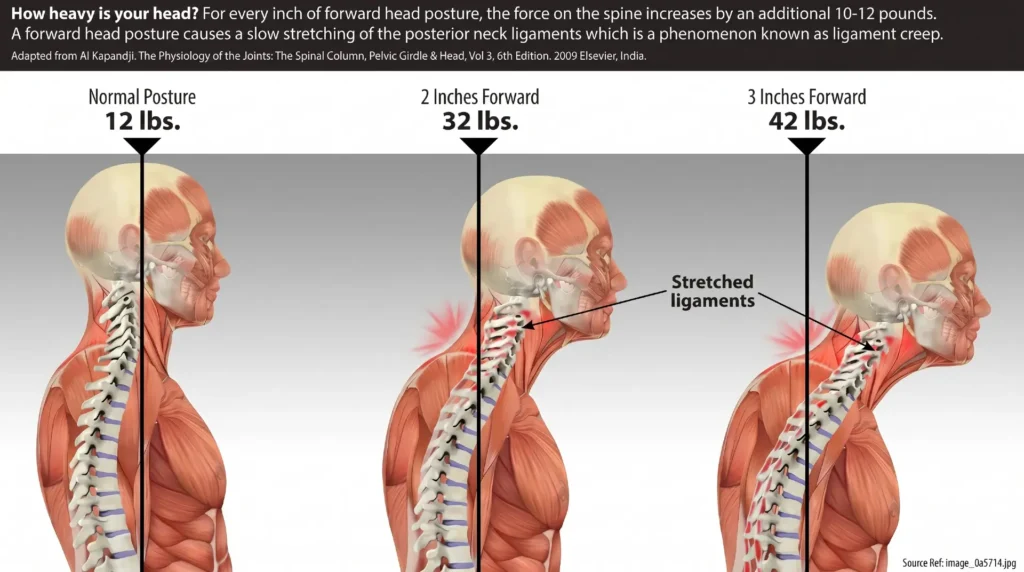
Start from the bottom. Let your foot land just under your body, not far in front of it. Keep your hips level, like there is a bowl of water sitting between your hip bones and you cannot spill it. Keep your spine upright. Lean very slightly forward from your ankles, not from your waist. Shoulders back and down. Head up. Think tall.
This alignment is sometimes called a neutral spine. It is the position where all the parts of your back share the load evenly instead of one area taking all of it.
Adjustment 3: Engage Your Core Gently, Not Forcefully
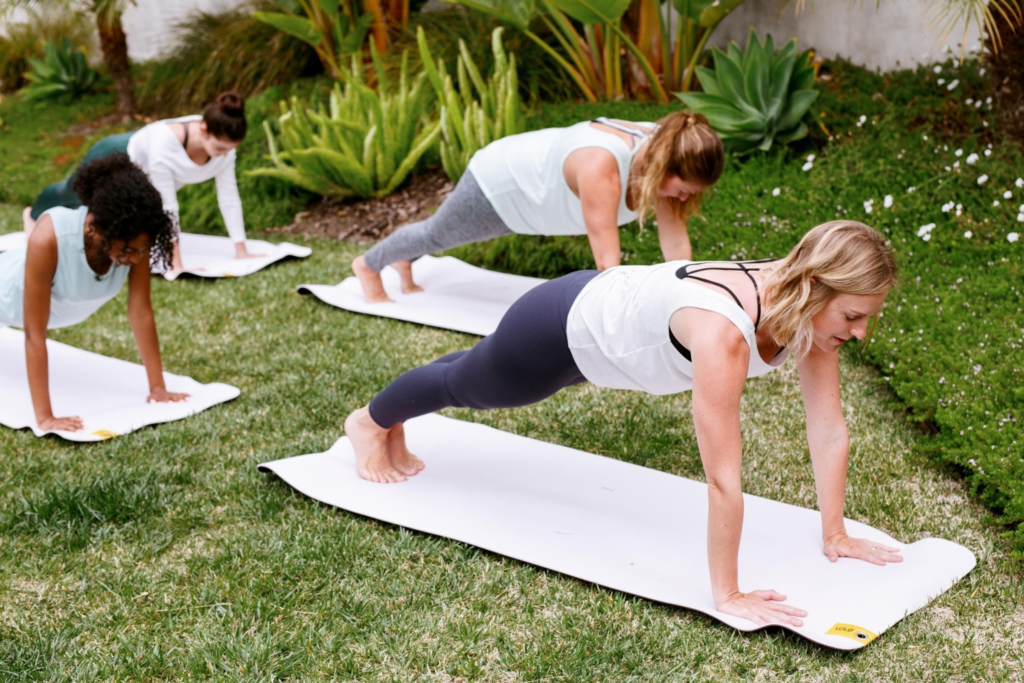
Pulling your stomach tight like you are bracing for a punch is not what you want. That kind of rigid bracing is actually counterproductive because it restricts the natural movement your spine needs.
Instead, think of pulling your belly gently back to neutral. A small, soft engagement. Enough to give the spine support. Not so much that it turns your torso into a board. The cue that works for a lot of people is simply thinking: belly gently in, not belly sucked in hard.
Adjustment 4: Roll Heel to Toe with Every Step
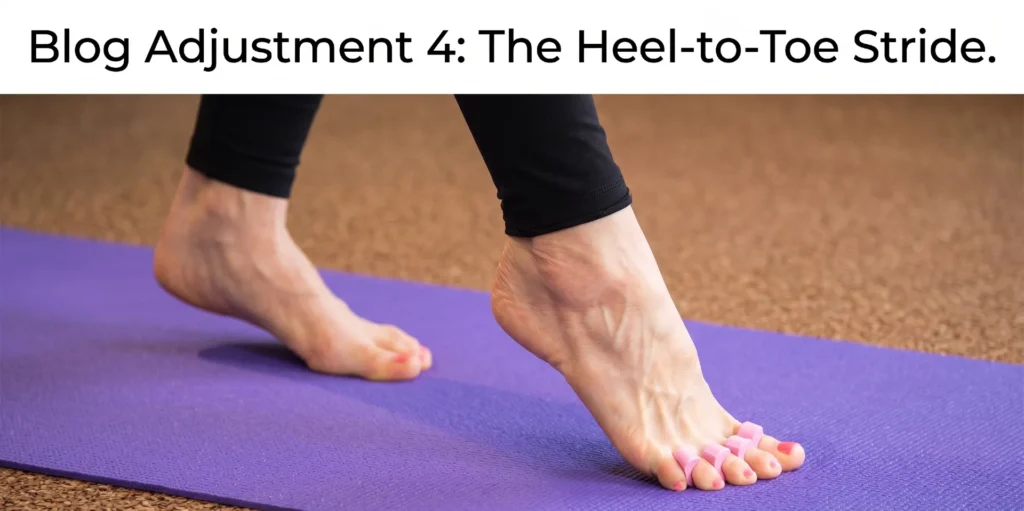
Land with the heel softly and then roll through the entire foot. Push away from the ground with your toes as the back leg leaves the floor. This heel-to-toe pattern distributes the impact of each step more evenly. It also increases ankle mobility and keeps the calf muscles active, which helps pump blood back up from your legs with every stride.
If you walk flat-footed or toe-first, this one adjustment can change how your whole lower body feels after a long walk.
Adjustment 5: Let Your Arms Swing Freely and Naturally
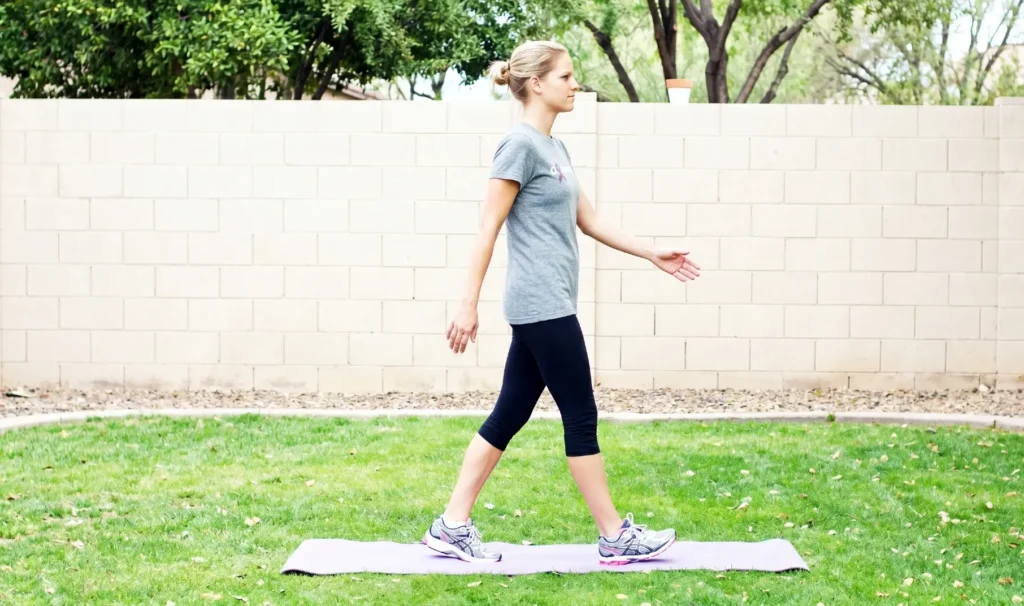
Opposite arm, opposite leg. That is the natural pattern. Left leg forward, right arm swings forward. Right leg forward, left arm swings forward.
Hands out of pockets. No gripping the phone. Let the arms move from the shoulders, not the elbows. If your arms feel stiff or awkward at first, they probably are. Years of restrictive habits leave their mark. But within a few walks, a natural rhythm comes back.
Adjustment 6: Keep Your Gaze Level and Slightly Ahead
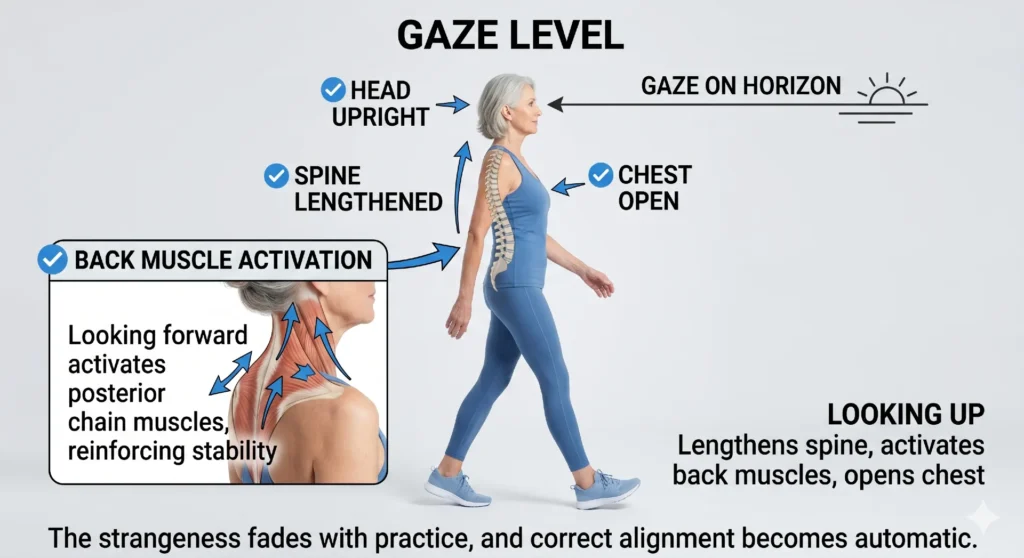
Look forward, not down. Your eyes should be on the horizon or slightly below it, not watching your feet.
Looking down pulls the chin forward, rounds the upper back, and compresses the lower back. It also activates a reflex that shortens your posture. Looking forward does the opposite. It lengthens the spine, activates the muscles along the back of the body, and opens the chest.
If desk work has given you a habit of leaning forward, it will feel strange at first to walk upright. That strangeness fades after a few sessions.
Quick Self-Check Before Your Next Walk
Before you take your first step, run through this in five seconds: chin level, shoulders back and down, belly gently in, hips neutral, hands free. Five things. Five seconds. The whole walk is set up correctly before you leave your driveway.
Getting the mechanics right matters even more once you start picking up the pace. And that is where the real anti-aging power of walking kicks in.
The Speed Connection: Why How Fast You Walk Predicts How Fast You Age
Researchers have started calling walking speed the “sixth vital sign.” Not blood pressure. Not heart rate. The speed at which a person walks down a hallway.
That sounds like an overstatement. It is not.
A study using data from 405,981 participants in the UK Biobank found that people who described themselves as brisk walkers had significantly longer telomeres than slow walkers. Telomeres are the protective caps on the ends of your DNA. Longer telomeres mean younger cells. Shorter telomeres mean the opposite.
The difference between brisk and slow walkers in that study? A biological age gap of 16 years. Not 16 months. 16 years.
A separate large review published in the Journal of the Post-Acute and Long-Term Care Medical Association looked at data from more than 30 studies involving over 34,000 participants. It found that for every 0.1 meters per second decrease in walking speed, the risk of death increased by 12%.
And an October 2025 study published in the American Journal of Preventive Medicine tracked nearly 85,000 adults across 17 years. It found that at least 15 minutes of fast walking per day was associated with a longer life.
The number that stands out most, though, is this one. Older adults who increased their walking pace by just 14 steps per minute saw significant improvements in physical outcomes. Not jogging. Not power walking. Just 14 more steps per minute.
Here is the important part, though. Speed is not the starting point. Speed with poor posture just amplifies damage. A long stride that wrecks your pelvis at a slow pace will do it even faster at a brisk one.
Fix the form first. Once the mechanics feel natural and automatic, start gently picking up the pace. That is the sequence that produces the anti-aging benefit without trading it for a wrecked lower back.
A Simple Week-One Walking Plan You Can Actually Use
Knowing the right form is one thing. Building the habit is something else entirely.
Most people read an article like this, try to remember six things on their walk, feel overwhelmed by step two, and give up. This plan takes the thinking out of it.
You do not start at 30 minutes a day, five days a week. That is the goal the WalkBack trial was building participants toward, but they got there gradually. You do the same.
Day 1 to 2: Walk 10 to 15 minutes. Focus only on posture and head position. Nothing else. Chin level. Shoulders back and down. Eyes forward. That is the whole job.
Day 3 to 4: Add the core engagement cue and the heel-to-toe foot roll. Keep the same duration. Two more things. Still manageable.
Day 5 to 7: Add arm swing awareness. Start noticing your stride length. If your lower back feels any strain at all, shorten your steps slightly. Just a little.
Week 2 onward: Add five minutes every few days. Once the posture holds automatically without you thinking about it, start gently increasing your pace.
Before every single walk, use this three-word cue: Stack, Brace, Swing.
Stack your spine. Chin level, shoulders back, body tall. Brace your core lightly. Belly gently in. Swing your arms. Hands out of pockets, shoulders relaxed.
Four seconds. Every walk set up right.
One honest note for anyone already dealing with back pain: walking is genuinely helpful for back pain and sciatica when it is done correctly with proper posture, shorter strides, and supportive shoes.
But if pain gets worse during or after a walk, stop and see a physical therapist or healthcare professional before pushing further. Not every back responds the same way, and a flare-up needs different handling than a prevention program.
For most people, consistency across three to four weeks is when the adjustments start to feel automatic. That is also when the back starts to notice the difference.
Your Back Is Not Breaking Down. It Is Just Waiting for You to Move Correctly.
Lower back pain is not inevitable. For most people, it is at least partly the result of how they move every single day.
Walking is one of the most accessible and proven tools available for protecting the spine. But only when the mechanics are right. Shorten the stride. Stack the spine. Brace the core lightly. Roll heel to toe. Swing the arms freely. Then, gradually, pick up the pace.
These six adjustments are backed by research from Macquarie University, the UK Biobank, and multiple clinical trials. They are not complicated. They just require you to pay attention for a few weeks until they become second nature.
Go for a walk today. Not tomorrow. Use the Stack-Brace-Swing cue before the first step. Your lower back, and your future self, will feel the difference.
