
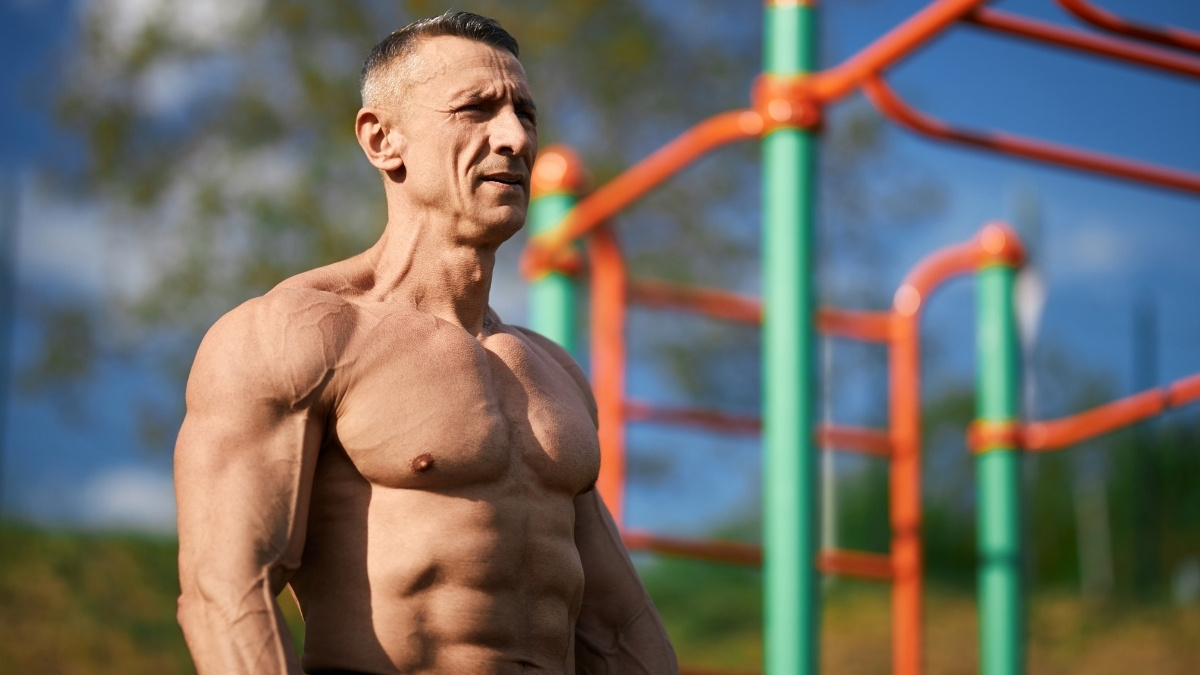
The doctor looked at Ned’s bone scan at 54 and said something Ned didn’t expect. “If you don’t start using resistance,” the doctor told him, “you’re going to break a hip before you’re 70.” Ned had been walking five miles a day for a decade. He thought that was enough.
Millions of people over 50 are doing the exact same thing Ned was doing. They’re staying “active.” They’re watching what they eat. They’re doing yoga, taking walks, maybe hopping on the elliptical a few times a week. And slowly, without realizing it, they’re losing muscle, losing bone density, and losing the physical independence they won’t miss until it’s gone.
The condition is called sarcopenia. It’s the medical term for age-related muscle loss. After age 50, you lose about 1 to 2% of your muscle mass every single year. Your strength drops 1.5% per decade, then speeds up to 3% per decade after age 60. About 25 to 45% of U.S. seniors have it.
Ned had been told the wrong things for years. Not by bad people. By well-meaning friends, cautious doctors, and a fitness industry that had decided older adults needed gentle movement, not serious training. That advice cost him years of strength and independence he could have kept.
Over-50 Strength Simulator
Discover if your current routine is fighting sarcopenia or feeding it based on clinical science.
Myth 1: Heavy Lifting Will Wreck Your Joints
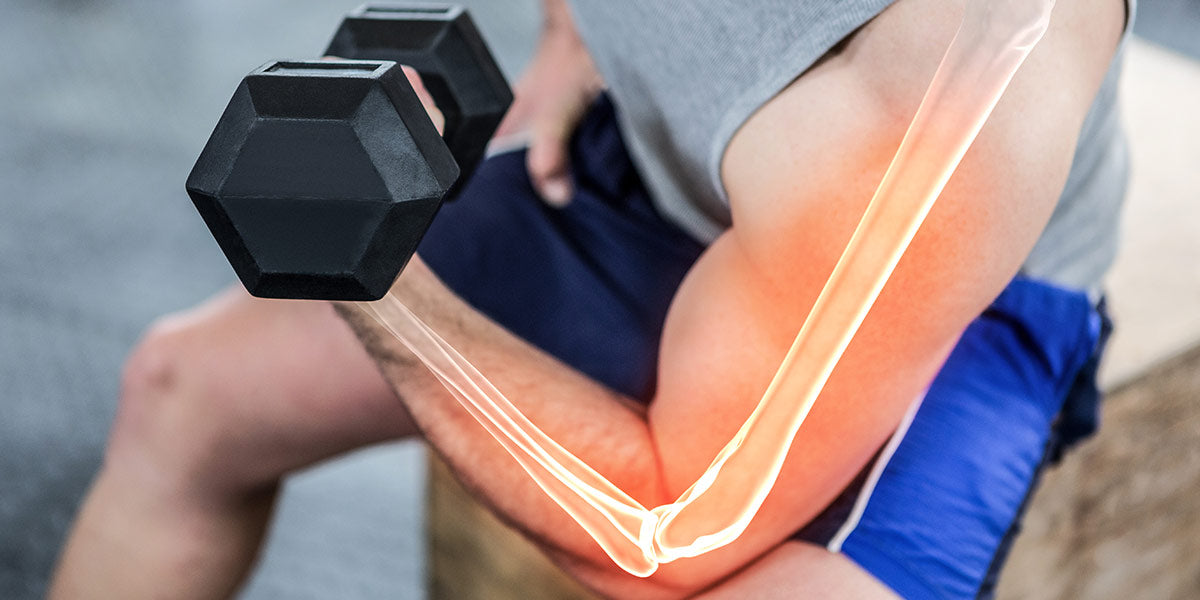
Ned had a knee that clicked. It had clicked for years, ever since a bad landing during a pickup basketball game in his late 30s. When his doctor mentioned “mild osteoarthritis” at a routine visit, Ned filed it away as confirmation: heavy lifting was not for him. Barbells were for young people with good joints.
A 2025 study in the Journal of Cachexia, Sarcopenia and Muscle found that heavy resistance training actually improves joint health, strengthens connective tissue, and reduces fall risk in older adults. The loading doesn’t damage the joint. When done correctly and progressively, it rebuilds the structures around it.
The key word there is “progressive.” Joints adapt when load increases slowly, over time, with good form. The injury risk in lifting isn’t the weight itself. It’s ego. It’s adding too much too fast. It’s skipping technique because you’re impatient.
Ned also learned something important about pain. There’s a difference between acute, sharp pain that signals “stop immediately” and the normal discomfort of muscles working under load. For years, he had treated every sensation as danger. That wasn’t wisdom. That was fear wearing a reasonable mask.
Eight weeks after starting with a certified trainer, something odd happened. The clicking in his knee had gotten quieter. The muscles around the joint were stronger. They were finally doing the work his joint had been doing alone for years.
The surrounding muscle is the joint’s support system. Without it, the joint does all the work. That’s what wears it down.
About 25 to 45% of U.S. seniors have sarcopenia. The muscle loss from that condition is far more dangerous to joint health than properly progressed strength training.
Source: UT Southwestern Medical Center
| What Ned believed | What the science actually shows |
|---|---|
| Heavy lifting damages aging joints | Progressive loading strengthens connective tissue |
| Clicking knees are a sign to stop | Strong surrounding muscles reduce joint stress significantly |
| Any pain from lifting means injury | Some discomfort is normal muscle adaptation |
| Light weights are safer for older adults | Heavy, well-progressed loads rebuild joint support structures |
Myth 2: It’s Too Late to Build Muscle. That Ship Has Sailed.
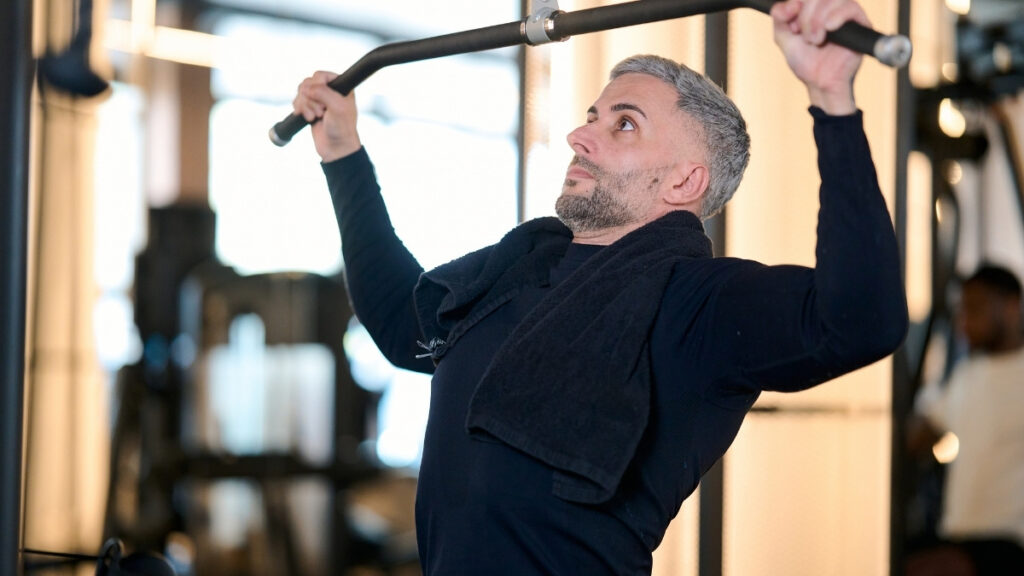
Ned sat in a gym lobby once, watching a man who looked about 60 pull heavy iron off a rack like it was routine. He remembers thinking: That’s not for me. My window for that has passed. That thought felt true. It was completely false.
Both men and women over 50 experience real gains in strength and muscle mass from resistance training. The adaptation is slower than it is at 25. But it doesn’t stop. It never completely stops.
Here’s the biology, explained simply. After age 50, your body develops something called anabolic resistance. Your muscle-building machinery gets less efficient. When you eat protein, a smaller percentage of it goes toward building muscle. When you lift, the signal to your muscles is weaker than it used to be.
But here’s what anabolic resistance doesn’t do. It doesn’t shut the system off. It just means you need a stronger signal. You need heavier loads and more protein per meal. The door isn’t closed. It just takes a harder knock.
A 2023 study published on ScienceDirect showed that progressive strength training can actually reverse sarcopenia in middle-aged and older adults, regardless of their genetic profile. Not slow it down. Reverse it.
Six weeks into his program, Ned’s leg strength had measurably improved. Not dramatically. Not Instagram-worthy. But real. And that small, real gain changed something in him. He texted his son a photo from the gym. His son texted back: “When did you start going to the gym?”
After age 50, muscle mass drops 1 to 2% per year and strength declines 1.5% per decade, accelerating to 3% after age 60. These numbers are not fixed. They are reversible with training.
Source: National Library of Medicine / PMC
| Age range | Annual muscle loss | Strength decline | With resistance training |
|---|---|---|---|
| 50 to 60 | 1 to 2% per year | 1.5% per decade | Significantly reduced |
| 60 and beyond | Accelerates | 3% per decade | Partially and measurably reversed |
| Any age over 50 | Ongoing without action | Ongoing without action | Gains are real and documented |
Myth 3: Ned Spent 10 Years Lifting Pink Dumbbells. Here’s Why That Held Him Back.
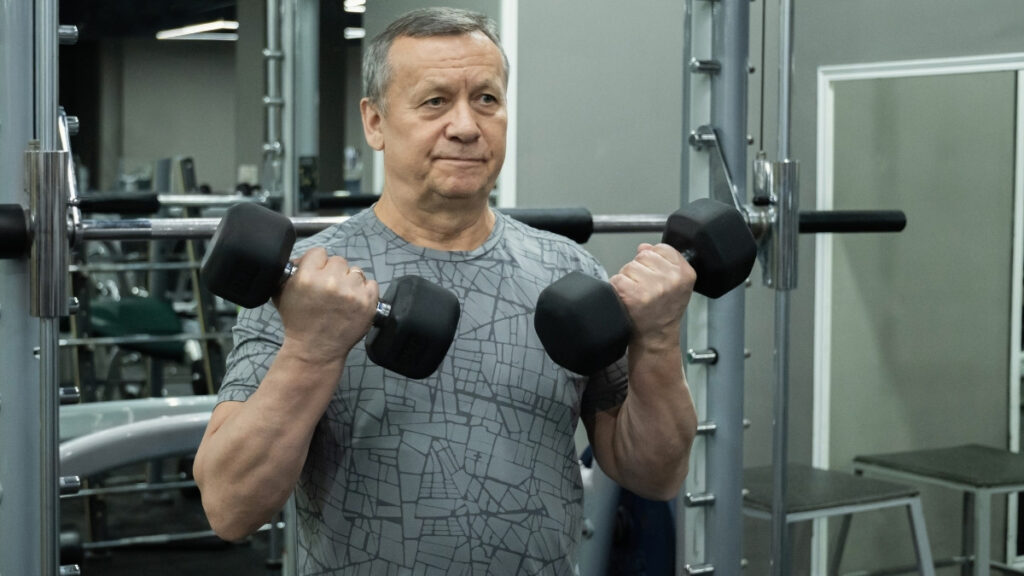
For ten years, Ned had a home workout routine. Two 8-pound dumbbells. Some resistance bands. A yoga YouTube channel he liked. He showed up four times a week. He never missed a session. He thought he was doing enough. He wasn’t even close to what his body needed.
Here’s the problem with light weights for older adults. They don’t build the kind of strength that keeps you safe. They don’t train what researchers call Rate of Force Development, or RFD. RFD is how fast your muscles can fire. It’s what catches you when you slip on ice. It’s what stops a fall in under 200 milliseconds, which is roughly how long you have before you hit the ground.
Light weights and high reps train endurance. They can help with general cardiovascular health. But they don’t develop explosive speed in your muscles. Heavy lifts, done with speed and intention, do that. And that explosive speed is what keeps you upright when your balance is tested.
A 2025 paper in the Journal of Cachexia, Sarcopenia and Muscle found something that surprised a lot of people in the fitness industry. Heavy-to-very-heavy training actually results in lower cardiovascular risk than high-rep training at light weight. More load, done correctly, is better for your heart than more reps with less weight.
A physical therapist told Ned something that stuck with him. She said: “If you trip, you have about 200 milliseconds to catch yourself. What you’ve been doing for the last decade doesn’t train that.”
Ned threw away the 8-pound dumbbells. He picked up a 30-pound kettlebell. He felt ridiculous. He came back the next day anyway.
Adults who skip strength training can lose 4 to 6 pounds of muscle per decade. Light weights alone cannot offset this loss at the rate the body requires.
Source: Harvard Health, August 2024
Myth 4: Ned Walked 5 Miles a Day and Still Got a Bad Bone Density Scan at 54

Ned wasn’t lazy. That’s what made his bone scan result so hard to hear. He walked five miles most mornings. He had a step counter he was proud of. He felt fine, cardiovascularly. And then his bone density scan came back “low-normal” and his grip strength test put him in the lower range for his age group.
The problem wasn’t that walking is bad. Walking is good. The problem is what walking simply cannot do. Walking doesn’t prevent sarcopenia. It doesn’t improve bone mineral density in any meaningful way. It doesn’t train the fast-twitch muscle fibers that keep you from falling.
A British Journal of Sports Medicine meta-analysis found that just one to two strength training sessions per week are associated with a lower risk of death than cardio alone. A Japanese meta-analysis found that muscle-strengthening exercises were linked to a 10 to 17% lower risk of all-cause mortality.
Ned didn’t quit walking. He added two days of lifting to his week. Three months later, his functional test scores had improved. Six months later, his bone density had stabilized. Ten years of daily walks hadn’t done that in a decade.
Sarcopenia affects about 8.85% of people aged 40 to 64, nearly doubling to 15.51% in those 65 and older. Walking cannot prevent it.
Source: UT Southwestern Medical Center
| Health benefit | Walking / cardio | Strength training |
|---|---|---|
| Heart and lung health | Yes, strong benefit | Yes, meaningful benefit |
| Prevents sarcopenia | No | Yes |
| Improves bone density | Minimal | Significant |
| Reduces fall risk | Partially | Strongly, targets fast-twitch fibers |
| Builds explosive muscle speed (RFD) | No | Yes, with heavy compound lifts |
| Lowers all-cause mortality risk | Yes | Yes, even stronger when combined |
Myth 5: The Bone-Breaking Fear That Kept Ned Away From the Squat Rack

When Ned’s doctor showed him the bone density results, her face was careful. “Low-normal for your age,” she said, in a tone that suggested caution. Ned walked out thinking he needed to protect his bones. Be gentle with them. Avoid anything that might stress them.
Bones respond to mechanical stress. When you load them, they get the signal to remodel and rebuild. When you avoid loading them, they don’t get that signal. Careful, gentle movement doesn’t protect aging bones. In many cases, it speeds up their decline.
A 2025 study published in the journal Bone followed 451 adults around retirement age for one year of heavy resistance training. Participants showed improved bone formation biomarkers. A separate Frontiers in Physiology meta-analysis confirmed that high-intensity resistance exercise is among the most effective interventions for improving bone mineral density in older adults without chronic disease.
The International Osteoporosis Foundation explicitly recommends resistance and balance training for patients with osteoporosis. Not in spite of their low bone density. Because of it.
Ned shifted his thinking. Avoiding stress doesn’t protect bones. It just means they decay without a reason to rebuild.
His next bone scan showed stabilization. He asked his doctor when the next one was scheduled. Light loading doesn’t trigger bone remodeling. Bones need mechanical stress to maintain their density. Avoiding that stress doesn’t protect them. It accelerates their decay.
Osteoporosis affects about 30% of all postmenopausal women in the U.S. and Europe, with 40% experiencing at least one osteoporotic fracture in their lifetime. Resistance training is the primary non-pharmacological intervention.
Source: PMC meta-analysis / International Osteoporosis Foundation
Myth 6: Ned Thought He’d Be Wrecked for a Week After Every Workout

When Ned pictured himself after a serious workout, he imagined being unable to climb stairs the next morning. He pictured waking up stiff, wrecked, unable to function for days. The gym, in his mind, was a place where older bodies went to break down.
He wasn’t entirely wrong that recovery matters more as you age. That part is real. But the picture he had drawn was wildly overblown.
Here’s what the research actually supports. Two to three strength training days per week, with full rest days in between, is the evidence-based starting point for adults over 50. Sessions of 30 to 45 minutes are what the research recommends, not two-hour marathons. Shorter sessions, done with precision, are often more effective than long ones.
Ned started with two 40-minute sessions per week. Simple compound movements: squats, deadlifts, bench press. He was never destroyed the next day. He was tired in a way that felt productive, like he had actually done something real. Three months in, he added a third session comfortably.
He had spent years dreading something that, it turned out, fit easily into a Tuesday and a Thursday. Progressive resistance training, 2 to 3 days per week, is the evidence-backed prescription for older adults.
Source: 2025 ICFSR Global Consensus on exercise and aging
| Day | Activity | Duration | Notes |
|---|---|---|---|
| Monday | Compound strength session | 40 minutes | Squat, deadlift, press |
| Tuesday | Rest or easy walk | 30 to 45 min | Low intensity only |
| Wednesday | Full rest | Any | Recovery is part of the work |
| Thursday | Compound strength session | 40 minutes | Same movements, slight load increase |
| Friday | Rest or easy walk | 30 to 45 min | Low intensity only |
| Weekend | Light activity or full rest | Flexible | No forcing it |
Myth 7: The Invisible Wall. Why Ned’s Gains Stalled Until He Fixed His Protein.

Ned had been lifting for two months. Showing up consistently. Doing the work. And somewhere around week eight, his progress stalled. Strength wasn’t moving. Energy felt flat. He hadn’t changed anything. That was exactly the problem. He hadn’t changed anything, including his diet.
Here’s what was happening inside his body. As you get older, something called anabolic resistance kicks in. A 25-year-old and a 55-year-old can both eat 20 grams of protein after a workout. The younger body builds significantly more muscle from it. The older body’s response is blunted. Not broken. Blunted.
The fix isn’t complicated, but most people over 50 don’t know it. You need more protein per meal, and you need it consistently. Stanford Lifestyle Medicine recommends 1.2 to 1.6 grams of protein per kilogram of body weight per day for adults over 50 who are training.
For a 165-pound person, that’s roughly 90 to 120 grams per day. About 30 to 35 grams of that should come within two hours of your workout.
Most people over 50 aren’t anywhere near this. Based on analysis of U.S. Dietary Guidelines data, about 30% of men and 50% of women over 71 are under-consuming protein. This isn’t about obsessing over food. It’s about being intentional with one nutrient your body is now less efficient at using.
Ned didn’t overhaul his kitchen. He made three small, specific changes. Two eggs and Greek yogurt at breakfast. A chicken breast at lunch. A protein shake or piece of fish at dinner. Three weeks later, his strength started moving again.
The ESPEN Expert Group recommends at least 1.0 to 1.2 g of protein per kilogram of body weight per day for healthy older adults, rising to 1.2 to 1.5 g/kg for those managing health conditions.
Source: ESPEN Expert Group / Stanford Lifestyle Medicine
| Meal | What Ned eats | Approx. protein |
|---|---|---|
| Breakfast | 2 eggs + Greek yogurt (plain, full-fat) | 30 to 35g |
| Lunch | Chicken breast + vegetables | 35 to 40g |
| Post-workout or dinner | Protein shake or a piece of fish | 25 to 35g |
| Daily total | Three straightforward meals | 90 to 110g |
What changed for Ned (and what can change for you). Ned didn’t start lifting to look like an athlete. He started because he was tired of shrinking.
And over 12 months, here’s what changed. His knee click quieted down. His bone density stabilized. His grip strength moved from low-normal to average for someone a decade younger. He carries his groceries without thinking about it. He takes the stairs two at a time.
None of those things happened because Ned was special. They happened because he stopped believing the myths.
The myth that his joints couldn’t take it. That his window for muscle growth had closed. That walking was enough. That light weights were safer. That heavy loading would snap his bones. That he needed days to recover. That protein was for bodybuilders.
If you’ve been telling yourself a version of Ned’s story, the science and his experience point in the same direction. It’s time to put that story down and pick something heavier up.
A good first step is finding a certified personal trainer or physical therapist before you begin. Look for CSCS or CES credentials and someone who has worked with adults over 50. Programs like Starting Strength and GreySteel are built specifically for people in this chapter of their life.
Strength training after 50 isn’t a luxury. It’s one of the most protective things you can do for the next 20 years of your life. And you don’t have to be ready. You just have to start.
| Myth | The fear | What the science shows |
|---|---|---|
| 1. Lifting wrecks joints | My knee can’t handle it | Progressive loading strengthens connective tissue and reduces joint pain |
| 2. Too old to build muscle | That window closed at 30 | Muscle and strength gains are real and documented at any age over 50 |
| 3. Light weights are enough | I’m being safe and active | Light weights don’t train RFD or prevent the muscle loss that matters most |
| 4. Cardio is enough | I walk every day | Walking is valuable but cannot prevent sarcopenia or improve bone density |
| 5. Lifting breaks bones | I have low bone density | Resistance training is the primary non-drug intervention for bone loss |
| 6. Recovery takes too long | I’ll be wrecked for days | Two 40-minute sessions a week is the evidence-backed starting point |
| 7. Protein is for bodybuilders | My diet is fine as-is | Anabolic resistance means you need more protein per meal, not less |
All statistics and research sources referenced in this article are real and current as of April 2026. Primary sources include: Journal of Cachexia Sarcopenia and Muscle (2025), Nature Communications (2025), Bone / PubMed LISA Study (2025), Harvard Health (2024), British Journal of Sports Medicine, UT Southwestern Medical Center, Stanford Lifestyle Medicine, ESPEN Expert Group, ICFSR Global Consensus (2025), and the National Library of Medicine.
